
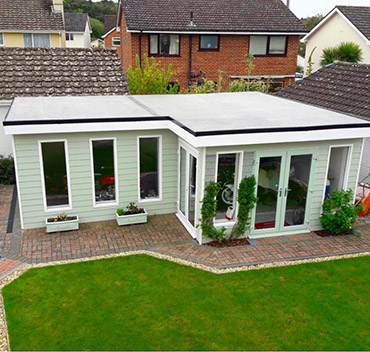
When somebody tells us their flat roof has failed three times in twenty years, they are almost always describing a felt roof. Torch-on felt is laid in overlapping sheets, and every one of those overlaps is a seam that can open up. Add the way felt hardens and goes brittle in UV light, and the failures become predictable.
What EPDM does differently
EPDM is a rubber membrane, and on most domestic flat roofs it goes down as a single sheet with no joins at all. No seams means nothing to come apart. It stays flexible through temperature swings rather than hardening, so the movement that cracks felt does not bother it.
The material itself carries a fifty year life expectancy. We would not claim every installation lasts fifty years – that depends on the deck underneath and how the edges are finished – but it is a different order of lifespan from felt.
The part that actually matters
Most flat roof failures we are called to are not really the membrane failing. They are the detailing: the upstands where the roof meets a wall, the drip edges, the outlet. That is where the work is, and it is where a cheap job cuts corners.
So when you compare quotes, the material is the easy bit to compare and the least important. Ask what happens at the edges.
When felt still makes sense
Occasionally it does – a very small area, or a repair to an otherwise sound felt roof where tearing the whole thing off would be wasteful. We will say so if that is the case. We would rather do the smaller job properly than sell you the bigger one.
